Testing and Calibration Software | TMCI Technology
INDUSTRIAL SOLUTIONS
Testing and Calibration Software
TMCI's Testing & Calibration Software is an intelligent, fully integrated platform designed to automate testing, calibration, data acquisition, instrument control, and reporting across laboratories, manufacturing facilities, calibration centers, and industrial environments. Featuring automated workflows, real-time data acquisition, digital record management, and comprehensive reporting, it improves accuracy, productivity, and traceability while reducing manual intervention. Its scalable architecture seamlessly integrates with test benches, calibration systems, Automated Test Equipment (ATE), and a wide range of test instruments, ensuring compliance with international quality and calibration standards.
Overview
TMCI’s Testing & Calibration Software is an intelligent, fully integrated platform designed to automate testing, calibration, data acquisition, instrument control, and reporting across laboratories, manufacturing facilities, calibration centers, and industrial environments.
Featuring automated workflows, real-time data acquisition, digital record management, and comprehensive reporting, it improves accuracy, productivity, and traceability while reducing manual intervention. Its scalable architecture seamlessly integrates with test benches, calibration systems, Automated Test Equipment (ATE), and a wide range of test instruments, ensuring compliance with international quality and calibration standards.
Intelligent Testing & Calibration Platform
Centralized software platform for managing testing, calibration, and instrument control efficiently.
Automated Test & Calibration Workflows
Automates test execution, calibration procedures, and reporting to improve efficiency and consistency.
Real-Time Data Acquisition & Monitoring
Captures, monitors, and analyzes live test data with seamless instrument communication.
Digital Reports & Complete Traceability
Generates digital reports, calibration records, compliance documents, and complete audit trails.
Scalable & Customizable Software Solution
Flexible architecture that can be customized to meet laboratory, industrial, and production testing requirements.
Automated Testing & Calibration
Automates complete testing and calibration procedures, reducing manual intervention while improving measurement accuracy, repeatability, and operational efficiency.
Instrument Integration
- Digital Multimeters
- Oscilloscopes
- Multifunction Calibrators
- Power Analyzers
- AC/DC Power Supplies
- Electronic Loads
- Signal Generators
- Frequency Counters
- Data Acquisition Systems
- Pressure Calibrators
- Temperature Calibrators
- PLC-Based Test Systems
- Automated Test Equipment (ATE)
- Third-Party Test Instruments
Real-Time Data Acquisition
- Voltage
- Current
- Power
- Resistance
- Frequency
- Temperature
- Pressure
- Flow
- Process Signals
- Analog & Digital Inputs
- Sensor Data
Intelligent Workflow Management
- Automated Test Sequences
- Calibration Procedure Management
- Operator Guidance
- Test Scheduling
- Instrument Configuration
- Workflow Automation
- Batch Processing
- Multi-User Access Control
Digital Documentation & Reporting
- Calibration Certificates
- Test Reports
- Pass/Fail Reports
- Compliance Reports
- Audit Logs
- Historical Data Records
- Trend Analysis
- Asset History
- PDF & Excel Export
Calibration Management
- Calibration Scheduling
- Due Date Notifications
- Instrument History
- Certificate Management
- Asset Tracking
- Recall Alerts
- Calibration Traceability
- Compliance Monitoring
Advanced Connectivity
- USB
- Ethernet (LAN)
- Wi-Fi
- RS-232
- RS-485
- GPIB
- Modbus
- OPC-UA
- CAN Bus
- SCPI Instrument Commands
Security & Data Protection
- User Authentication
- Role-Based Access Control
- Password Protection
- Audit Trail
- Secure Database Storage
- Automatic Data Backup
- Data Encryption
- Electronic Signatures (Optional)
Flexible Software Configuration
- Customer-Specific Test Modules
- Industry-Specific Calibration Templates
- Custom Report Formats
- Database Integration
- ERP/MES Integration
- Barcode & QR Code Support
- Cloud Connectivity
- Dashboard Customization
- Multi-Language Support
Test & Measurement Laboratories
Centralized control of laboratory instruments and automated testing.
Electronics Manufacturing
Functional testing and electronic product validation.
Automotive Industry
Automated testing of ECUs, sensors, and electronic systems.
Aerospace & Defence
Traceable testing and compliance reporting for critical applications.
Power & Energy
Testing electrical equipment, power systems, and energy meters.
Industrial Automation
PLC testing, control system validation, and process monitoring.
Research & Development
Prototype testing, performance evaluation, and experimental analysis.
Educational Institutions
Engineering laboratories and technical training environments.
Medical Device Manufacturing
Testing, validation, and regulatory documentation for medical equipment.
Quality Assurance Departments
Inspection, reporting, and compliance management across manufacturing operations.
Testing & Calibration Software
Digital software solutions for controlling test sequences, collecting measurement data, performing calculations, managing calibration records, and generating structured reports.
A Digital Layer for Modern Test Systems
Modern testing and calibration environments generate large volumes of measurement data. Engineers need efficient ways to control tests, collect measurements, analyze results, and maintain reliable records.
Testing and Calibration Software provides a digital layer that can connect test equipment, calibration instruments, data acquisition systems, automation platforms, and users within a structured testing workflow.
It can help automate test sequences, capture measurement data, perform calculations, manage test procedures, generate reports, and maintain organized calibration records.
TMCI Technology
- Test Benches
- Automated Test Equipment
- Calibration Systems
- Laboratory Furniture
- Power Supplies
- Test & Measurement Instruments
- Customized Testing Solutions
What Is Testing & Calibration Software?
Software used to control, automate, document, analyze, and manage testing and calibration activities.
Why Is Testing & Calibration Software Important?
A centralized digital workflow can reduce repetitive manual operations and support more standardized testing processes.
Automated Test Procedures
Software can guide or execute predefined test sequences, reducing repetitive manual operations.
Accurate Data Collection
Compatible instruments and sensors can send measurements directly to the software.
Faster Calculations
Deviations, tolerances, corrections, and other configured calculations can be performed automatically.
Digital Documentation
Test results and calibration information can be stored electronically for reporting and future reference.
Improved Repeatability
Standardized test sequences can help different operators follow the same procedure.
Centralized Information
Equipment information, procedures, measurements, and reports can be managed through a common environment where supported.
How Does It Work?
Testing and Calibration Software can operate as a communication and control layer between operators, equipment, standards and DUTs.
Select Procedure
Select the device or required test procedure.
Identify Instruments
Identify the required compatible instruments.
Connect Equipment
Connect compatible Test & Measurement equipment.
Load Sequence
Load the appropriate predefined test sequence.
Apply Conditions
Apply the defined test conditions.
Collect Data
Acquire measurement data from connected equipment.
Compare Results
Compare values with references or defined limits.
Calculate
Perform configured calculations and evaluations.
Evaluate
Determine the applicable test result.
Store Information
Store test information and measurement records.
Generate Report
Generate structured test or calibration reports.
Key Features
A comprehensive software platform can combine multiple testing, measurement, documentation and management functions.
Test Sequence Management
Define the order in which measurements and operations are performed for standardized testing.
Instrument Communication
Communicate with compatible instruments through supported interfaces and protocols.
Automated Measurement
Collect readings directly from compatible instruments instead of entering every value manually.
Calibration Calculations
Perform configured deviation, error, correction, tolerance and related calculations.
Pass / Fail Evaluation
Compare results against configured acceptance criteria and identify measurements outside defined limits.
Report Generation
Convert collected measurement data into structured testing and calibration documentation.
Data Storage
Store test and calibration results for future reference, subject to system architecture and database configuration.
User Management
Enterprise and laboratory systems may provide roles and permissions for controlled access.
Audit Trails
Where required, systems can maintain records of changes to procedures, results and configurations.
Instrument Communication
Software can communicate with compatible Test & Measurement instruments through supported interfaces and protocols.
What Can Instrument Communication Enable?
Depending on the connected equipment and software architecture, communication can support:
- Instrument configuration
- Measurement triggering
- Data acquisition
- Parameter monitoring
- Automated test control
- Result collection
Testing & Calibration Software for Test Benches
Modern test benches combine physical equipment with software-based control and data acquisition.
Power Supplies
Provide controlled power conditions for test procedures.
Measurement Instruments
Collect electrical and physical measurements.
Sensors
Capture application-specific physical parameters.
Signal Generators
Provide defined test signals for connected devices.
Controllers
Coordinate equipment and defined test operations.
Data Acquisition
Collect and process measurement information.
Switching Systems
Manage signal routing within automated test environments.
Safety Systems
Support controlled test operations where applicable.
Computer Interfaces
Provide the software control and user interface layer.
For example, a Motor and Drive Test Bench may collect voltage, current, torque, speed, temperature and power measurements, while a Relay & PLC Test Bench may control I/O sequences, simulate signals, monitor outputs and record test results.
Software for Calibration Laboratories
A digital workflow can help organize instruments, standards, procedures, measurements, reports and calibration records.
Testing & Calibration Software for ATE
Automated Test Equipment combines hardware and software to perform defined testing procedures.
Test Sequences
Execute predefined testing procedures in a controlled order.
Instrument Control
Coordinate compatible measurement and test instruments.
Switching
Control switching systems within automated test setups.
Signal Generation
Coordinate signal sources required by the test procedure.
Data Acquisition
Collect measurement information from connected equipment.
Safety Interlocks
Coordinate applicable safety interlock functions.
Calculations
Perform configured calculations within the test workflow.
Pass / Fail
Evaluate measurements against configured acceptance criteria.
Reporting
Generate structured records from completed test procedures.
Testing & Calibration Software Applications
Different test systems require different software functions based on the measurements, equipment and procedures involved.
Electrical Testing
Acquire voltage, current, resistance, frequency, power and other measurements from compatible instruments.
Temperature Calibration
Coordinate temperature sources, reference sensors, measurement equipment, test points and calibration records.
Pressure Calibration
Support pressure sequences, reference measurements, DUT readings, calculations and reporting.
Motor & Drive Testing
Collect torque, speed, voltage, current, power, temperature and efficiency parameters.
Relay Testing
Control test sequences and capture electrical and timing characteristics.
PLC Testing
Support signal simulation, I/O monitoring, sequence validation, communication and documentation.
Benefits of Testing & Calibration Software
A suitable software layer can improve workflow organization, automation, measurement handling and documentation.
Reduced Manual Data Entry
Direct instrument communication can reduce manual entry of measurement values.
Improved Test Repeatability
Standardized software-controlled procedures can support consistent testing workflows.
Faster Testing
Automated sequences can reduce repetitive operator activities.
Better Data Organization
Digital storage can make test and calibration information easier to organize and retrieve.
Automated Reporting
Software can generate structured reports from collected measurement information.
Traceable Records
Digital records can provide historical information about instruments, tests, procedures and results.
Scalable Testing
Software-controlled systems can be expanded as testing requirements become more complex.
Testing Software & Data Acquisition
Data acquisition collects information from sensors, instruments and test equipment for software-based processing and evaluation.
From Measurement to Result
Depending on the application, software can store, calculate, visualize, evaluate or report acquired information according to the configured test procedure.
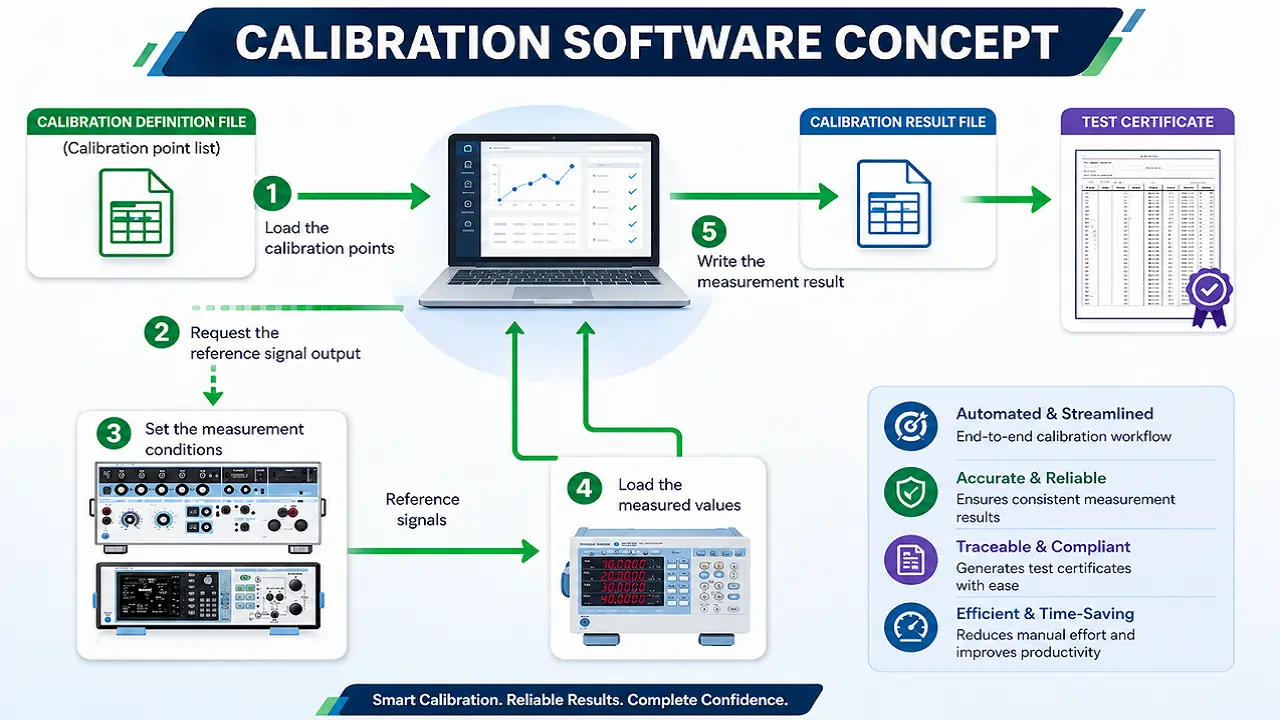
Automated Calibration Workflow
A software-controlled calibration process can be organized into structured stages from device identification to documentation.
Device Identification
Identify the DUT using an asset number, serial number or suitable identifier.
Procedure Selection
Select the appropriate calibration procedure.
Equipment Verification
Identify required reference standards and instruments.
Test Execution
Guide or control the calibration sequence.
Measurement Collection
Collect reference and DUT measurements.
Calculation
Perform configured calculations and determine deviations.
Result Evaluation
Compare results with defined acceptance criteria.
Documentation
Store results and generate applicable reports or certificates.
Testing & Calibration Software for Global Industries
Testing and calibration requirements exist across industrial sectors for manufacturing, quality control, maintenance, R&D, process control and other technical applications.
Defence & Aerospace
Support application-specific testing and measurement workflows where required.
Automotive
Connect test infrastructure with measurement, automation and data management.
Power & Energy
Support measurement-intensive testing and calibration environments.
Pharma & Laboratories
Organize testing and calibration workflows around controlled measurement processes.
Manufacturing
Connect physical test infrastructure with digital records and defined testing procedures.
R&D & Industrial Applications
Provide a structured digital layer for measurement, experimentation and test documentation.
TMCI Technology & Testing Solutions
Testing and Calibration Software can form part of an integrated environment connecting hardware, automation, data acquisition and test procedures.
TMCI's engineering approach considers instruments, test parameters, automation requirements, workflow and reporting needs when developing application-focused testing environments.
TMCI Technology as a Calibration Test Bench Manufacturer
TMCI Technology positions itself as a top calibration test bench manufacturer in India, with capabilities spanning test benches, automation, calibration, laboratory infrastructure and Test & Measurement.
Test Bench Manufacturing
Application-specific physical testing infrastructure.
Automated Test Equipment
Hardware and software based automated testing environments.
Calibration Systems
Structured systems for calibration applications.
Laboratory Furniture
Workstations and infrastructure for technical environments.
Power Supplies
Power infrastructure for test and measurement applications.
Test & Measurement
Measurement equipment for integrated testing environments.
Fluke & HAROGIC
TMCI is also an authorized dealer for leading brands including Fluke and HAROGIC, supporting customers with Test & Measurement and calibration equipment as part of complete testing solutions.
How to Choose Testing & Calibration Software
Software selection should be based on the testing environment, connected equipment and long-term operational requirements.
Instrument Compatibility
Confirm communication with required instruments and interfaces.
Test Automation
Determine manual, semi-automated or fully automated requirements.
Data Management
Evaluate storage of measurements, records, results and reports.
Reporting
Identify reporting and certificate requirements.
Scalability
Consider future instruments, users, procedures and stations.
Security
Consider roles, access control, backups and data protection.
Integration
Evaluate PLC, database, ERP, laboratory and instrument integration.
Technical Support
Consider implementation, updates, troubleshooting and training.
Frequently Asked Questions
Common questions about Testing & Calibration Software.
What is Testing and Calibration Software?
It is a digital platform used to control tests, communicate with instruments, collect measurements, perform calculations, evaluate results, store data and generate reports.
What does Testing and Calibration Software do?
Depending on the application, it can automate test sequences, control instruments, acquire measurements, perform calculations, evaluate pass/fail conditions, store results and generate reports.
Can it control Test Benches?
Yes, where compatible hardware and interfaces are available, software can control test bench equipment, measurement instruments, signal sources, switching systems and other components.
Can calibration calculations be automated?
Yes. Configured calculations such as deviations, errors, corrections and tolerance evaluations can be performed according to the applicable procedure.
Can it generate reports?
Yes. A suitable software system can generate structured test and calibration reports using collected measurement data and configured report templates.
Can it connect to Test & Measurement instruments?
Yes, provided the software supports the relevant instrument, communication interface, driver and protocol.
Can TMCI Technology provide integrated testing solutions?
TMCI Technology designs and manufactures Test & Calibration Solutions including Test Benches, Automated Test Equipment, Calibration Systems, Laboratory Furniture, Power Supplies and Test & Measurement solutions.
Which industries use Testing & Calibration Software?
Applications can support Automotive, Defence & Aerospace, Power, Pharma, Manufacturing, Electronics, Industrial Automation, Energy, R&D and other measurement-intensive industries.
The Future of Testing & Calibration Software
Testing environments are becoming increasingly connected, automated and digitally managed.
Connected & Digital Testing
Modern laboratories and industrial facilities are moving toward automated measurement, digital records, instrument connectivity, centralized data, remote monitoring and software-driven test procedures.
Build an Integrated Testing Environment
Connect measurement instruments, test benches, calibration systems, data acquisition, automation and reporting into a structured testing environment with TMCI Technology.
Explore TMCI Technology